
Well – FUNcube-1 has now been in orbit and fully operational for one month.
We are very happy and VERY grateful to all the stations who have committed their time and effort into regularl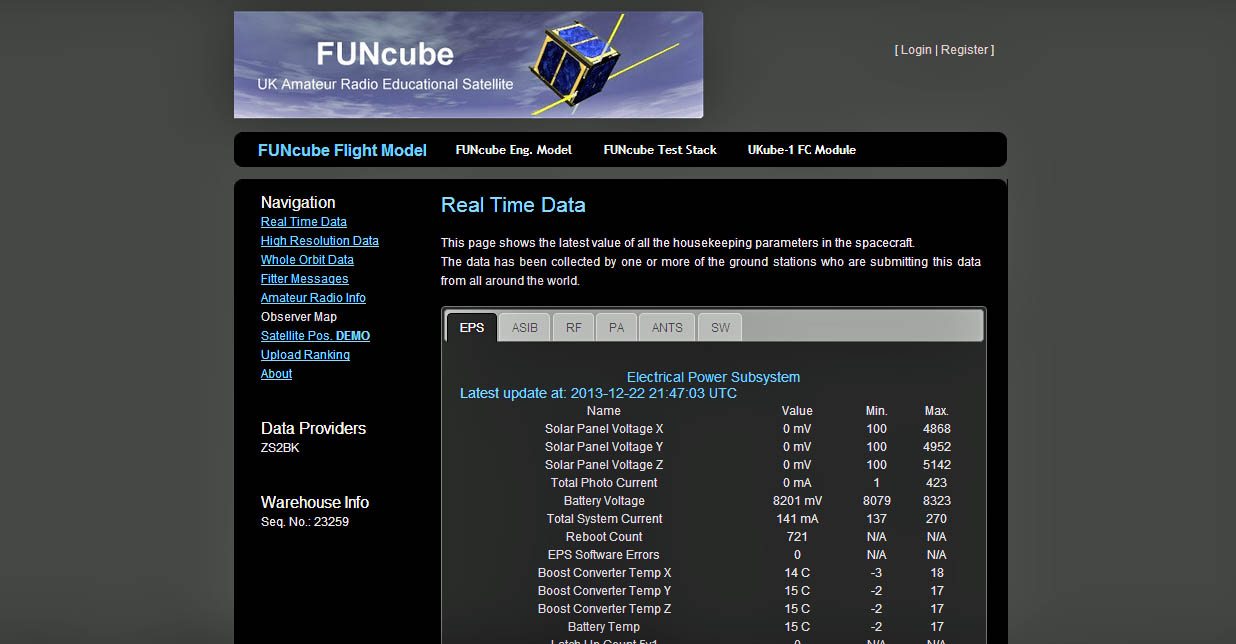 y receiving the telemetry and uploading it to our Data Warehouse. We really want to say a BIG THANK YOU and please keep it coming.
Dave G4DPZ is still busy refining the operation of the Warehouse and is promising more features over the next few days/weeks. Further updates to the Dashboard are also expected soon.
If anyone knows of potential additional stations that could be established in some of the remoter parts of the globe we would be grateful to have your ideas and introductions. “Simple” stations with omnidirectional antennas, dongles and internet connected laptops would be all that is needed.
We intend to keep the present operating schedule in place for the time being whilst various on board parameters continue to be characterised by the team.
The present low internal temperatures being experienced by the spacecraft, at least in the northern hemisphere, are causing some frequency shifting to take place – especially on the uplink frequencies – roll on summer!
We are not yet 100% certain that Object 2013-066AE is FUNcube-1 but it is looking the most likely candidate.
As the launch was more than 30 days ago, the record for this object has now moved to the http://celestrak.com/NORAD/elements/cubesat.txt file and the object is now referred to as DNEPR OBJECT AE.
The https://funcube.org.uk/working-documents/latest-two-line-elements/ page has been updated to match.
73! de the FUNcube team
Just a few minutes after our last post on the subject we received viable information that suggests that FUNcube-1 is actually object 2013-066AE
Here is an email that has just been circulated to the AMSAT-BB
Subject: Re: [amsat-bb] Re: Object IDs
Hi all, The story so far!
The first object number that was issued for the contents of ISIPOD-1 – ie HinCube, FUNcube-1 and ZAcube was 2013-066B
Some days later, 2 new objects were identified -2013-66AE and 2013-066AF.
Generally we thought that the best fit for FUNcube-1 was object 2013-066AF but more recent evaluations by our expert trackers now shows that FUNcube-1 is most probably 2103-066AE.
They are still only about 100km apart after almost a month in orbit. So we have been correct to hang back a bit before making any claims!
The FUNcube team will monitor results for just a little longer before doing so.
Our “latest tles” page has been updated again to reflect this change!
https://funcubetest2.wordpress.com/working-documents/latest-two-line-elements/
73
Graham
We believe that the best fit for FUNcube-1 is object 2013-066AF and the latest TLEs have just been updated here:
https://funcubetest2.wordpress.com/working-documents/latest-two-line-elements/
Some days ago Mike DK3WN posted a screenshot of his reception of the beacon using this set of keps and the FUNcube-1 team has been using them with great success for some days now.

But before we “claim” the Object, we are going to wait for a few more days – just to be certain!
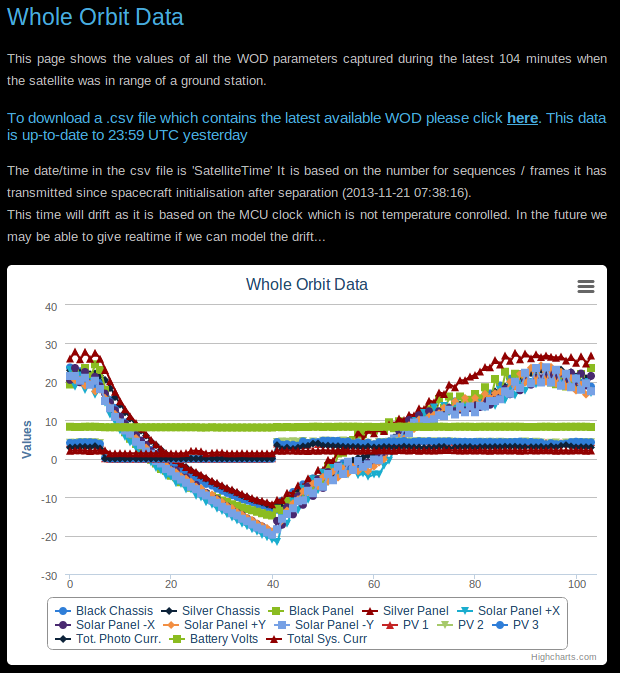
The Data Warehouse now provides the facility to download Whole Orbit Data as a .csv file. The file is produced at 23:59 every day and contains data for the preceding 24 hours. It contains all the channels shown on the WOD graph, which shows the latest orbit data captured.
As expected, today we have seen two new objects appear on the Kep files from SpaceTrack and Celestrak.
These are 2013-066AE and 2013-066AF – and they appear to be very close to the object number we have been using for FUNcube-1 , 2013-066B.
We will see which of three turn out to be the best match for FUNcube-1 over the forthcoming days.
Nico, PA0DLO, has recently emailed his observations which align with our own understanding of the current situation:
“AMSAT-OSCAR 73, ZACube 1 and HiNCube were launched from the same ISIPOD.
As they initially were close together, the JSpOC decided to release only one TLE set for this cluster under object number 39417 (2013-066B). Now the distances between these satellites are slowly increasing. So the question is – which satellite is object 39417?.
Detailed doppler measurements show that ZACube 1 is now about 25 s early compared to the TLE for object 39417, while OSCAR 73 is about 11 s early. This seems to indicate that object 39417 is actually HiNCube.
Hopefully TLEs for OSCAR 73 and ZACube 1 will be published soon.”
Hi,
We are doing some work on improving the WOD display, please bear with us if the upload server and UI drop out a few times today while we make the changes.
Pressing F5 / Reresh will upload the latest version of the Warehouse if it appears to have stopped.
You don’t have to do anything to the Dashboard, it will back off transmissions until it detects the server again.
Thanks
– Dave
Apologies to everyone who was expecting the transponder to be active during daylight today.
A late change of plan by the team means that we did not send that command but concentrated on testing some other functionality. As a result, the sharp eyed will notice that one of the ANTS Data sensor channels has been commanded “OFF” (this shows as failed” on the Dashboard). It does NOT indicate any problem with the on board systems though.
The spacecraft will continue with its autonomous schedule for the time being.
Thanks!
What are the funny characters in the FM9 slot?
Well the command stations can re-purpose FM9 to either be a “normal” fitter message or to carry the debug data that is displayed at the bottom of the Dashboard. This carries info about various status flags and other parameters.
The format is described here
“in short fitter message 9, when we are running in debug mode starts of with 0xFF that’s how we know its debug, then what follows is just a byte for byte copy of some of the in memory structures from the running MCU, filling up the rest of the fitter message is an MCU program trace (read from right to left) the letter indicates the source file, the number is the line number in that source file. The spaces are where the MCU has finished processing and has gone back to wait for more events.”

Hi,
We can now display 104 minutes of Whole Orbit Data captured within the satellite.
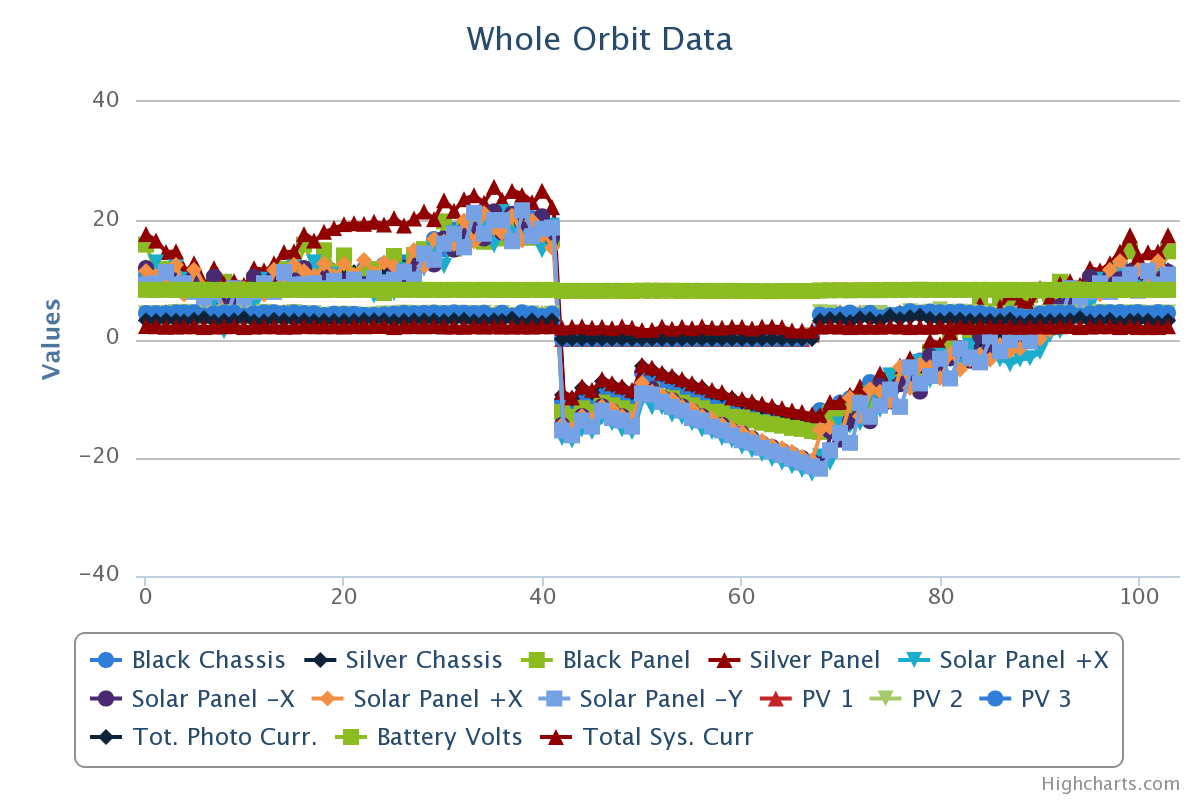
We are working on getting the scaling factors such that all values can be displayed within the same range.
E.g Volts instead on mV, Amps instead on mA. Etc.
Part of the MSE experiment is nicely represent in this graph:
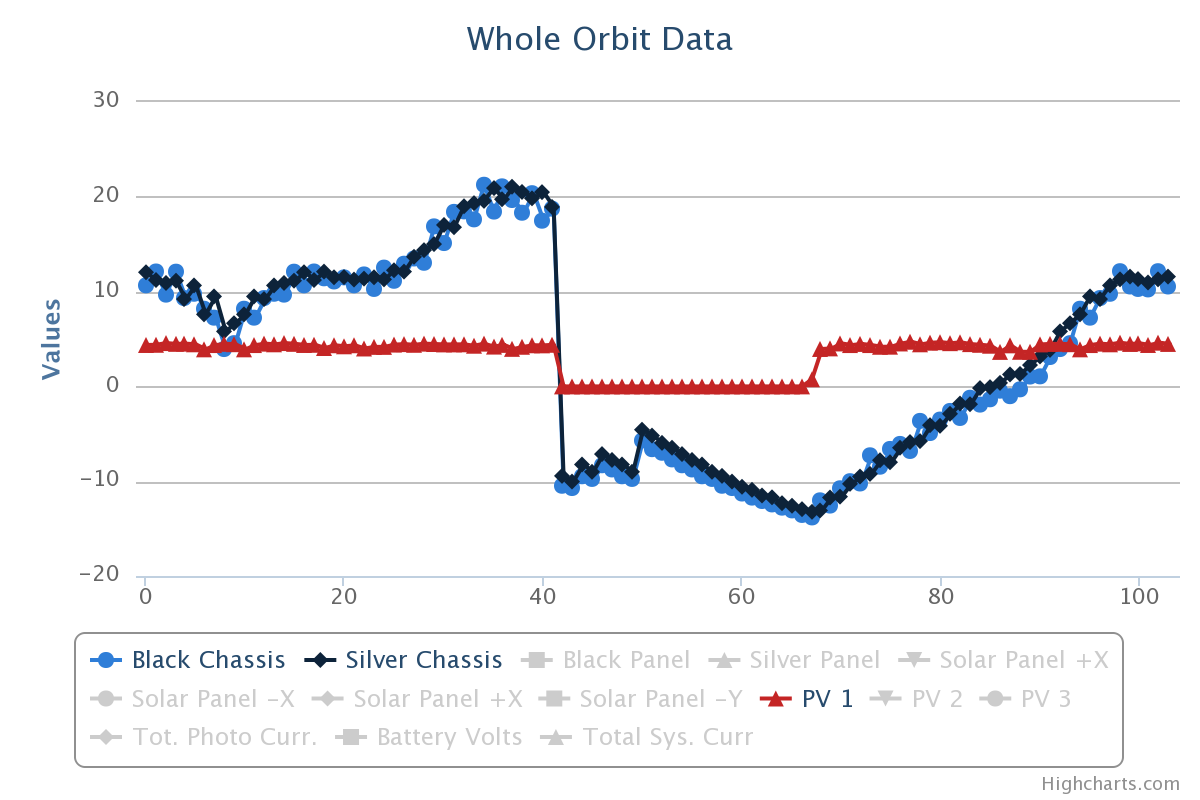
Heating and cooling when the spacecraft is in sunlight as indicated by the Solar Cell (PV1) voltage.
We will be moving on to High Resolution data next and then mechanisms for downloading the data for local analysis.
Enjoy!
73
– Dave, G4DPZ


 Welcome to the FUNcube Web Site