
The attitude of AO73/FUNcube-1 is passively stabilised using the traditional magnet and two hysteresis rods. Since the launch over four years ago we have been intrigued with the resultant actual spin rate/period which seems to vary over time for reasons that have not yet been properly explained.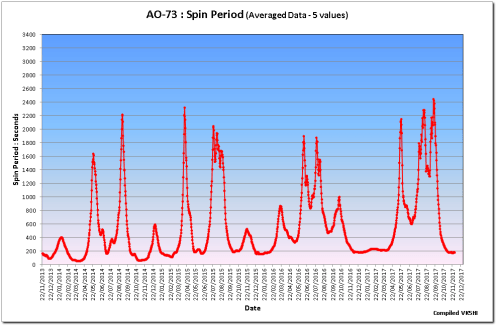
This graphic, which has been developed from telemetry received and maintained by Colin, VK3HI, and his team, shows the variations in some detail. Explanations would be gratefully received.
As it is expected that illumination levels may be having an influence, the next few months and years will prove interesting. The spacecraft will be entering periods of continuous sunlight. Initially this will be for a six-week period but then for periods of up to nine months!
This illustration from Mike, DK3WN’s, illum.exe software shows the predicted duration of the first period.
Today, November 21st 2017, marks the fourth birthday for FUNcube-1 in orbit.
FUNcube-1 was launched at 07:10 UTC on November 21st 2013 and its first signals were received immediately after deployment over the Indian Ocean by amateurs in South Africa. Since then it has been operating continuously in either its education mode or, with the transponder active, in amateur mode when in eclipse and at weekends.
The spacecraft has spent the four years in space orbiting the earth at between 640 and 580 km and has now travelled around the earth more than 20,000 times. That represents a distance travelled of approaching 500 million miles.
Up to now, each of the orbits has been spilt approximately 65% in sunlight and 35% in eclipse. This has resulted in the temperatures inside the small spacecraft varying by about 25o C during each orbit.
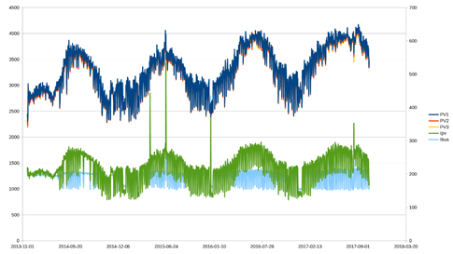 During the recent AMSAT Colloquium, Wouter, PA3WEG, during his presentation about the FUNcube project mentioned that the power available from the solar panels has been slowly increasing since launch. This observation led the team to do some further investigations as to the cause.
Although the launch was into a nominally Sun Synchronous orbit, over time this has drifted and the spacecraft is now entering a period when it will be in the sun for longer periods during each orbit.
The exact details are still being determined, but it seems likely that, starting from January 2018, there will be periods when the spacecraft will be in the sun for all, or almost all, of its orbits. Of course, this means that the on-board temperatures will be much higher than we have previously experienced in flight, although we have some test records from pre-flight thermal air testing that were undertaken after integration.
The key will be to discover what the equilibrium temperature will be internally. For comparison, AO85 has already “enjoyed” periods of full sun and its internal temperatures have reached up to around 55o C.
So the next few months will be quite an exciting time for the team! We remain extremely grateful to everyone is using the spacecraft for both its educational and amateur missions. Of course we are also very very grateful to those who are downloading the telemetry and uploading the data to the Data Warehouse. It continues to provide a unique record of “life on board” a 1U CubeSat in space.
During the final satellite integration training for Jordan’s first satellite, JY1-SAT, the team was supported for the final stages of integration by His Royal Highness Crown Prince Al Hussein bin Abdullah II. The spacecraft has been given to students of the Masar Initiative at the Jordan University of Science and Technology as part of the JY1-SAT mission support and training program under the Crown Prince Foundation given by ISIS – Innovative Solutions In Space and AMSAT UK and AMSAT Netherlands,.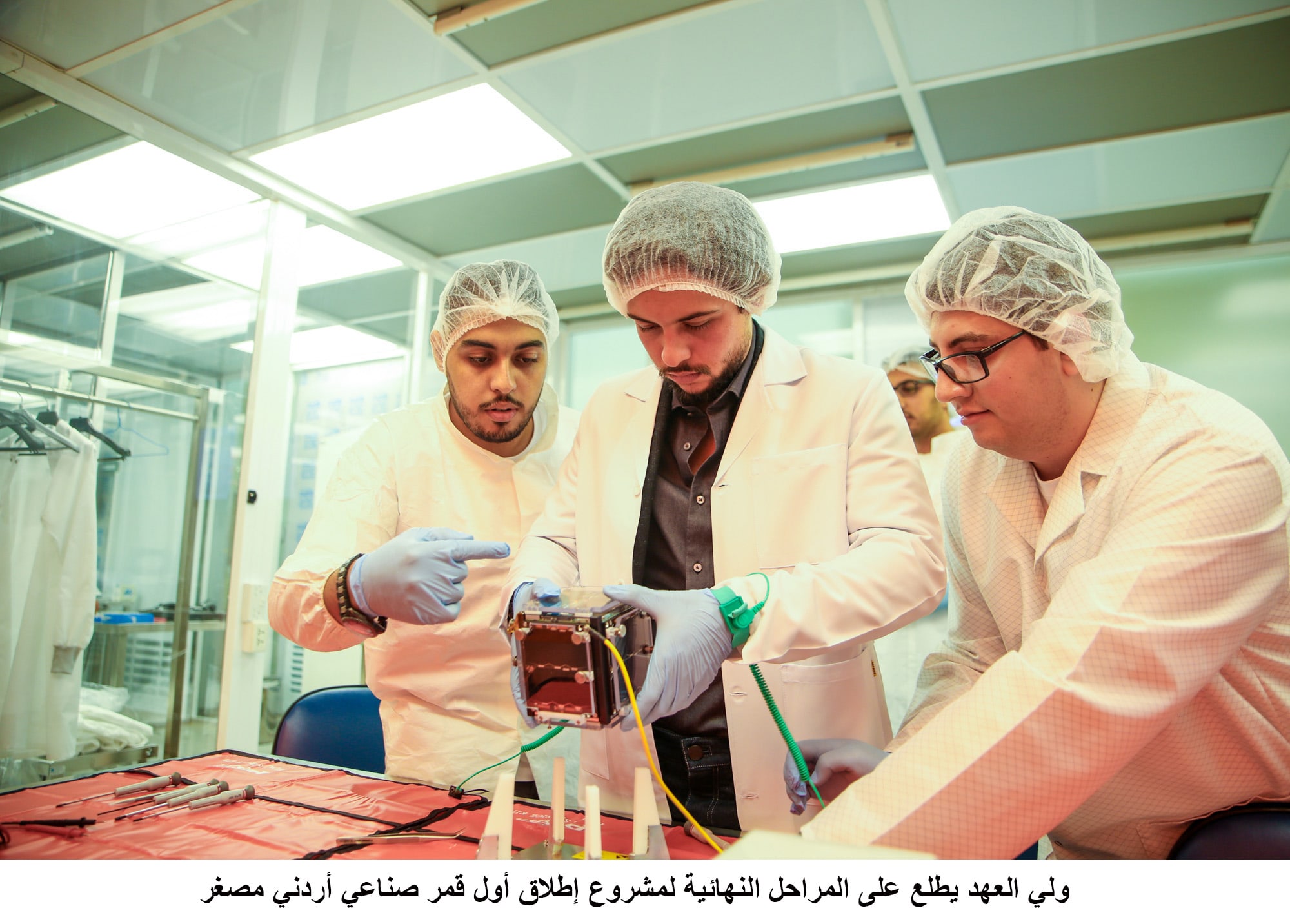
The JY1-SAT mission was proposed by Jordanian students who participated in the first batch of the cooperation program with NASA, after which the interns had suggested the design and launch of the first Jordanian satellite CubeSat.
To build up the capability to design and develop such a first mission, the Crown Prince Foundation signed a support agreement with ISIS – Innovative Solutions In Space and the AMSAT Radio Amateur Societies of the UK and the Netherlands, for hardware and training support, building on ISIS’ and AMSAT’s experience with FUNcube radio amateur transponder missions.
As a special development for the JY1-SAT mission, AMSAT has expanded the capabilities of the FUNcube transponder to be able to transmit stored images reflecting the Jordanian culture and its historical heritage, along with a voice message recorded by the Crown Prince to be transmitted in space to receivers around the world.
The launch of the JY1-SAT, scheduled during the first half of next year, is in memory of His Majesty the late King Hussein, the first founder of the HAM Radio in Jordan and holder of call sign JY1.
 JY1-SAT will have a linear, inverting, transponder downlinking between 145.855 & 145.875 MHz with the uplink between 435.100 & 435.120 MHz. The telemetry downlink will be on 145.840MHz and be FUNcube compatible. A new Dashboard will be made available before the launch of JY1-SAT
Nayif-1
Nayif-1 has now been in orbit for more than two weeks and all systems continue to operate nominally. The power budget is positive, the spin/tumble rate is acceptably low, on board temperatures are perfectly ok and, importantly, the educational/amateur transponder switching is taking place autonomously as planned.
This image, by ISRO, shows the moment of deployment of Nayif-1.
Nayif-1 has also been granted an “OSCAR” number and now has the secondary title of “EO88 – Emirates Oscar 88”.
More than 250 stations around the world have provided telemetry to the Nayif Data Warehouse and we are extremely grateful to them for their invaluable support.
The experts have now formally allocated Catalog Number 42017 to Nayif-1 (EO88) and the TLEs can now be downloaded from all the usual sources. For instance, go to Celestrak – TLEs
New Dashboards
We have now updated the Dashboards for both Nayif-1 and FUNcube-1 so that they display only the telemetry received from the individual spacecraft that they are designed for. This will help users to display only the correct information and graphs and reduce confusion. Whilst they only display the data from ONE spacecraft, they will, as now, receive and decode the data from all FUNcube payloads currently in orbit and automatically submit it to the relevant Data Warehouse.
The new Dashboard for FUNcube-1 (ver 1044) can be downloaded from here: FUNcube-1 Dashboard Installer 1044
The new Dashboard for Nayif-1 (ver 1040) can be downloaded from here: Nayif-1 Dashboard Installer 1040
Additionally some command line parameters have been added to enable the programmes to auto-start with the desired parameters. These are:
/minimized
/autostart
/source=dongle
or
/source=soundcard
Some notes on how to impliment these parameters can be found here: funcube-dashboard-autostart

All the tlm numbers “in the green”! With the Nayif-1 patch and lapel badge
Nayif-1 was successfully launched at 03:58UTC on February 15th 2017 and good signals were soon heard by stations in North America. We are pleased to be able to confirm that the first telemetry was submitted to the warehouse by Christy Hunter, KB6LTY, who will be receiving a specially produced Nayif-1 lapel badge and woven mission patch. Many thanks to everyone who was listening and sending reports, recordings or submitting data.
The satellite looks to be in perfect health and it was placed in autonomous mode before the end of the first day in orbit. Just like FUNcube-1, this mode has the spacecraft sending high power telemetry when in sunlight and with the transponder active when in eclipse. Already many contacts have been made through the transponder. As expected, the frequency stability of this spacecraft is much better than its predecessors.
The launch provider has published a video of the deployment of the 104 satellites. https://youtu.be/3KqTr1oNYwk The image here shows Nayif-1 just after deployment from the launch vehicle.
A new post-launch set of TLE’s has been issued by the launch authority and it can be downloaded from here
Please note that these numbers are not based on JSpOC observations so we do not yet have a valid catalog number.
During the Launch and Early Operation phase (LEOP) of the mission, the Nayif-1 command team have been headquartered at the American University of Sharjah Ground station in the United Arab Emirates. They have been very grateful for all the telemetry received from around the world. It has proven to be immensely useful to the team in checking that the spacecraft is functioning correctly.
Our world-wide network has greatly impressed the many professionals that have been watching our activities. Already more than 100 ground stations are submitting data to the Nayif Data Warehouse. Please continue uploading the data as this will further enhance our knowledge about the spacecraft and the space environment through which it is travelling at 7.6 km/s.
The Data Warehouse has been updated and can be seen here: http://data.amsat-uk.org/nayif1/index It now includes the Whole Orbit and High Res graphs and the upload ranking. It also includes telemetry details from the ADCS sub-system – this is called the iMTQ and is capable of actively magnetorquing. Over the coming days, we will be further tweaking the warehouse, so bear with us if it is unavailable for short periods of time.
A slightly updated Nayif-1 Dashboard is now available – this corrects one graphing error for negative values. It can be downloaded from here:http://download.funcube.org.uk/nayif-1_Dashboard_1039_Installer.msi
Guidance notes for setting this up are here : Guidance Notes
A reminder that if you are already a registered user of the FUNcube Dashboard then you do not need to re-register. Your existing details will transfer automatically to the new Dashboard when you run it for the first time.
The launch time for the Nayif-1 CubeSat remains as 03:58UTC on February 15th 2017 on the PSLV C37 vehicle. We expect the launch to be webstreamed at http://webcast.gov.in/live/
A set of pre-launch TLEs have been released:
NAYIF
1 17002U 17002A 17046.17824931 0.00000000 00000-0 00000-0 0 9993
2 17002 97.5521 107.5843 0004848 278.6481 296.8511 15.21991390 01
This file can also been downloaded from here http://download.funcube.org.uk/nayif_tle.txt
We now expect that the FUNcube transmitter on Nayif-1 will activate at approximately 04:47 UTC Feb 15th. (NB – This is a revised AOS and it is still Tuesday evening in America!) Initial transmissions will be in “safe” mode and will be of the 1k2 BPSK telemetry only with approx 50mW of RF power on 145.940MHz.
 At this time the spacecraft will still be over the Southern Pacific Ocean but AOS in Mexico is expected at around 04:54 UTC and the first pass will then track northwards in range of stations situated in the western US and Canada.
During the Launch and Early Operation phase (LEOP) of the mission, t he Nayif-1 command team will be headquartered at the American University of Sharjah Ground station in the United Arab Emirates. They will obviously be especially keen to have all possible reports of signal reception during this first orbit! To encourage everyone to take part, there will be a small prize for the stations that submit the first data to the Nayif-1 Data Warehouse. Please help the team if you can.
Details of the Nayif-1 frequencies, together with details of how to the download the Dashboard can be found here
https://funcube.org.uk/2017/02/08/nayif-1-launch-date-now-confirmed/
The Data Warehouse is still under final development but can be viewed here: http://data.amsat-uk.org/nayif1/index
Please note that if you are already a registered user of the FUNcube Dashboard then you do not need to re-register. Your existing details will transfer automatically to the new Dashboard when you run it for the first time.
If you run the test file with the Nayif-1 Dashboard please do not expect the Warehouse to show the data – it is from an earlier date than that is already displayed. However the “packets uploaded” tab at the bottom right corner of your Dashboard will show that the files have uploaded OK, that all is well with your system and that it is ready for action.
The AMSAT-UK and -NL team will also be using the #funcube IRC channel on launch day and you will be very welcome to join them there. If you do not have the Dashboard available then also please submit your heard reports via IRC as well. A web client can be found at http://irc.lc/freenode/funcube if you do not have an IRC client installed.
 Nayif-1, a 1U CubeSat, which has a full FUNcube payload, is scheduled for launch on an Indian PSLV launch vehicle at 03:58 UTC on February 15th 2017. The flight, C-37, will be carrying a total of 104 satellites into orbit.
Nayif-1 has been developed by the Mohammed bin Rashid Space Centre (MBRSC) and American University of Sharjah (AUS). The UAE’s first Nanosatellite was developed by Emirati engineering students from AUS under the supervision of a team of engineers and specialists from MBRSC within the framework of a partnership between the two entities, aiming to provide hands-on experience to engineering students on satellite manufacturing.
The spacecraft includes a U/V linear transponder and telemetry transmitter. It employs enhanced oscillator circuitry and includes an active attitude determination and control system.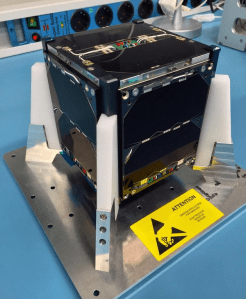
As with previous missions carrying FUNcube payloads, AMSAT-UK would very much like to receive as many reports from stations around the world, especially during the first few minutes and hours after launch.
There is a mission specific Telemetry Dashboard for this project and this can be downloaded from http://download.funcube.org.uk/Nayif-1_Dashboard_1038_installer.msi and, in a similar way to the FUNcube-1 Dashboard, this will be capable of uploading the telemetry received to a central Data Warehouse.
Guidance Notes for the installation of the Dashboard, integration with a FUNcube Dongle and the Data Warehouse have been prepared for the Nayif-1 mission. These can be downloaded here Nayif-1 Dashboard Notes
A file to test that the Dashboard and Warehouse configuration are working correctly can be downloaded from http://download.funcube.org.uk/nayif1_testfile.funcubebin
The operating frequencies for the spacecraft will be:
Telemetry
145.940MHz using 1k2 BPSK to the FUNcube standard.
Transponder
Uplink on 435.045 – 435.015MHz
Downlink on 145.960-145.990MHz
Initial operations of the spacecraft will be in a low power “safe” mode where only the telemetry transmitter is activated.
More details about the launch, exact deployment time and pre-launch TLE’s will be made available as soon as they become available, in the meantime we greatly appreciate your support.
Today, November 21st 2016, marks the third birthday in space for our baby, 985 gram, spacecraft.
FUNcube-1 was launched at 07:10 UTC on November 21st 2013 and its first signals were received immediately after deployment over the Indian Ocean by amateurs in South Africa. Since then it has been operating continuously in either its education mode or, with the transponder active, in amateur mode when in eclipse and at weekends.
The FUNcube team are very grateful to everyone who has been contributing their telemetry records to the Data Warehouse and also to those who are using FUNcube-1 for educational outreach to schools and colleges around the world. This important part of our mission is intended to encourage young people to develop an interest and passion in all STEM subjects for their future.
The spacecraft is operating nominally – the telemetry indicates that all the sub-systems are fine. The battery voltages, solar panel charge currents and on board temperatures are virtually unchanged since launch.
In addition to FUNcube-1, there are now similar FUNcube transponders operating in low earth orbit on the UKube-1 and EO79/QB50p1 CubeSats.
The team has recently contributed to the development of Nayif-1, which is presently awaiting launch, and is currently working on a number of further CubeSat and microsat projects.
HAPPY BIRTHDAY AO73!
AMSAT-UK and AMSAT-NL working with ISIS BV are delighted to announce that the FUNcube U/V transponder, on the 2U CubeSat QB50p1, has now been activated with a regular schedule.
Due to power budget constraints the transponder cannot be operational 24/7 and an orbit specific schedule has been developed. The transponder will commence operation 27 minutes after the spacecraft enters sunlight and will stay on for a period of 25 minutes. This schedule may be modified over the forthcoming weeks as a result of experience.
The transponder frequencies are:
Uplink: 435.047-435.073 MHz LSB
Downlink: 145.971-145.946 MHz USB
And the output power is approximately 400mW.
Qb50p1 was launched in June 2014, as a collaborative effort led by the von Karman Institute and ISIS-BV, into a sun synchronous 620×600 km polar orbit as a precursor spacecraft for the QB50 mission. The primary function of the satellite was to test a number of the systems and science payloads. This phase has now been completed and we are grateful to VKI and ISIS BV for carrying this transponder into space and, again, to ISIS, for developing and uploading the new, required, flight code.
We hope you have lots of fun using EO79!
FUNcube-1 was launched into space two years ago on November 21st 2013.
We are delighted to be able to report that more than 900 stations, including many schools around the world, have received the telemetry from the spacecraft since launch. Our Data Warehouse is storing more than 750 MB of data from almost 1 million data packets. We are very grateful to everyone who has been contributing to the success of this mission. Please continue to keep the data flowing as it will provide a valuable resource for students in the future.
The stats continue – speeding along at around 17,500 mph, FUNcube-1, which had a launch mass of just 982 grams, has completed more than 10,500 orbits of the earth. This means a total distance travelled of more than 260 million miles.
All telemetry sensors continue to provide valid data, real time, whole orbit and high resolution channels alike. The flight code is really robust and we have only had three unexpected “events” since launch. Two of these we believe to have been caused by noise of the command receiver being incorrectly interpreted as a command and only one appears to have been caused by a RAM error. The battery and solar panels also continue to work perfectly and provide a very positive power budget.
We have sent out many Fitter messages for school and other similar events. Earlier this week there was a demonstration at Thorne Green Top School in Yorkshire. Here is a report from Dave EI4HT/M0GIW: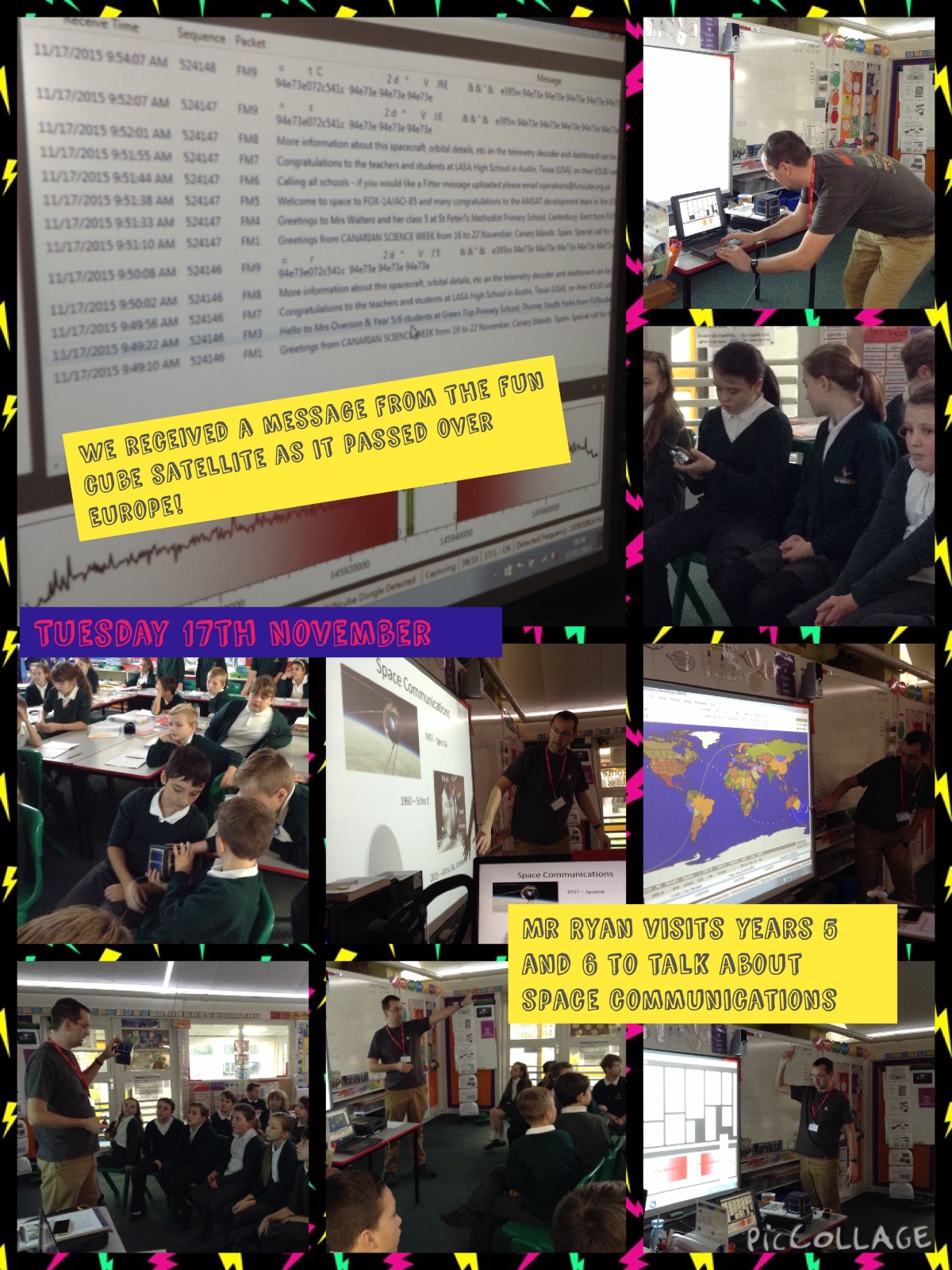
Good Morning All
Firstly -thanks to all for your help, we had a great morning at Green Top and the highlight was FUNcube.
I started with a slide show talking about communications from cave paintings all the way up to smartphones, we looked at space communications and travel from Sputnik to Astra and Apollo to the Millennium Falcon! We spoke about satellites and how they are used every day and how we all got to watch “I’m A Celebrity” via Satellite last night from Australia.
I brought in lots of props too, some old Motorola MX330 radios, some PMR 446, and a marine band radio .I also had a small model of a CubeSat that I knocked up over the weekend, I also passed around some NOAA images from last week’s Abigail storm and I had a few QSL cards from ISS and MIR from years ago when I lived in Ireland. I even had the memory foam earplugs I brought along on the first mission.
The FUNcube pass was great, really strong signals, I had my turnstile and FCD set up and had audio through speakers and used the class projector to show Satpc32 and the Dashboard.
There was a great buzz of excitement when we got the first packet and even more when the Fitter messages came through. The kids were fascinated to see the signal arrive just as the software predicted and then hear the telemetry and the decode.
After the pass we were able to look at the Warehouse online and print off the QSL card and certificate.
I didn’t get a chance to take many pics but Mrs Overson will update the School Blog and she took lots of pics.
http://greentopschool.co.uk/blog
Once again thanks to all at FUNcube, looking forward to Tim Peake on the ISS in the New Year and planning another visit to the School then.
Regards
Dave EI4HT / M0GIW
PS: I was back dropping my own kids off this morning and Mrs Overson told me they have printed a QSL card and Certificate for each of the students and they have used them for their class journals.
As well providing a great educational resource, FUNcube-1 operates at night and generally at weekends with the linear transponder active for radio amateurs to use for communications. The transponder continues to provide an excellent service. As users will be aware, the transponder uplink frequencies vary with receiver temperature. The RX temp telemetry channel is the best one to use for tracking this effect. This does make it quite difficult to use full computer control for transponder operations and we have already developed new oscillator circuits to improve this performance for future missions.
For the telemetry uplinked to the Data Warehouse, it is possible to download special Certificate or QSL Card here http://amsatuk.me.uk/on/funcube_qsl.php and, for transponder users, the “73 on 73 award” continues at http://amsat-uk.org/funcube/73-on-73-award/
The Nayif-1 CubeSat mission, which includes a full FUNcube payload, is expected to be launched into a similar orbit in the first half of next year and will provide an additional level of service to the community.
Meanwhile we hope everyone will continue to have fun with FUNcube-1!


 Welcome to the FUNcube Web Site